
On a Cyprus terrace, the evening is the point. Doors stay open, the table stays laid, and people stay outside long after the light has gone. That is why a terrace deserves a lighting plan of its own, separate from the garden paths and the façade: the terrace is a room, and it is used like one.
People searching for "patio lights" usually have something specific in mind, a string of lamps or a few spots near the dining table. Those are fittings, not a scheme. The question worth asking first is simpler: what happens on this terrace after dark, and where do people actually sit?
Start with the way the terrace is used
Most villa terraces carry three or four separate uses. There is a dining table. There is a softer seating area, often turned towards a view or a pool. There is a threshold where the terrace meets the house, and usually a step or a change of level that needs to be read underfoot. Each of those wants a different quantity and direction of light.
When all of it is served by one bright fitting overhead, the result is a car park with cushions. When each zone gets its own modest light source, the terrace gains depth, and the eye relaxes. The practical test is whether a guest can read a menu at the table while the person opposite is still comfortable to look at.
Layers, not a single source
A terrace scheme that works after dark usually has three layers.
The first is orientation light: very low output at floor level, enough to read a step, a kerb or the edge of a water feature. The second is task light: the table, the serving surface, the barbecue, a little brighter and tightly aimed. The third is atmosphere: light placed on surfaces rather than on people. A stone wall grazed from below, a clipped olive lit from one side, the underside of a pergola picking up a warm wash.
The layer most often missing is the third one. Without it, the terrace becomes an island and the garden beyond it turns into a black wall. One or two fittings pushed out past the edge of the paving, so that something is visible at the boundary of the terrace, make the whole space feel larger than it is.
Warm colour, kept low
Colour temperature decides whether a terrace feels like a living room or a service corridor. Dark Sky International's lighting principles recommend warm-coloured light sources outdoors, with a correlated colour temperature at or below 3000K, along with fittings that are shielded so the light goes where it is needed and not into the sky or a neighbour's bedroom. On a terrace used for dining, warmer still, around 2700K, tends to sit better against limestone, timber and terracotta.
Light sources sold in the EU carry ecodesign and energy labelling information under Commission Regulation (EU) 2019/2020, which makes it straightforward to compare output and efficiency before buying rather than after. Read the lumen figure rather than the wattage, because the wattage of an LED tells you little about how bright the terrace will feel.
Glare is what shortens an evening
If a fitting is visible at eye height from a seated position, the brain works harder and the eye stops adapting to the dark. The fix is nearly mechanical: get the source out of the sightline. Recess it, shield it, aim it down, or put it behind planting.
Some habits we return to on terrace projects: keep fittings below seated eye level or well above standing eye level, light the vertical surfaces rather than the air, and dim everything. A scheme at full output on the first evening is almost certainly too bright by the third.
Planting that holds light well
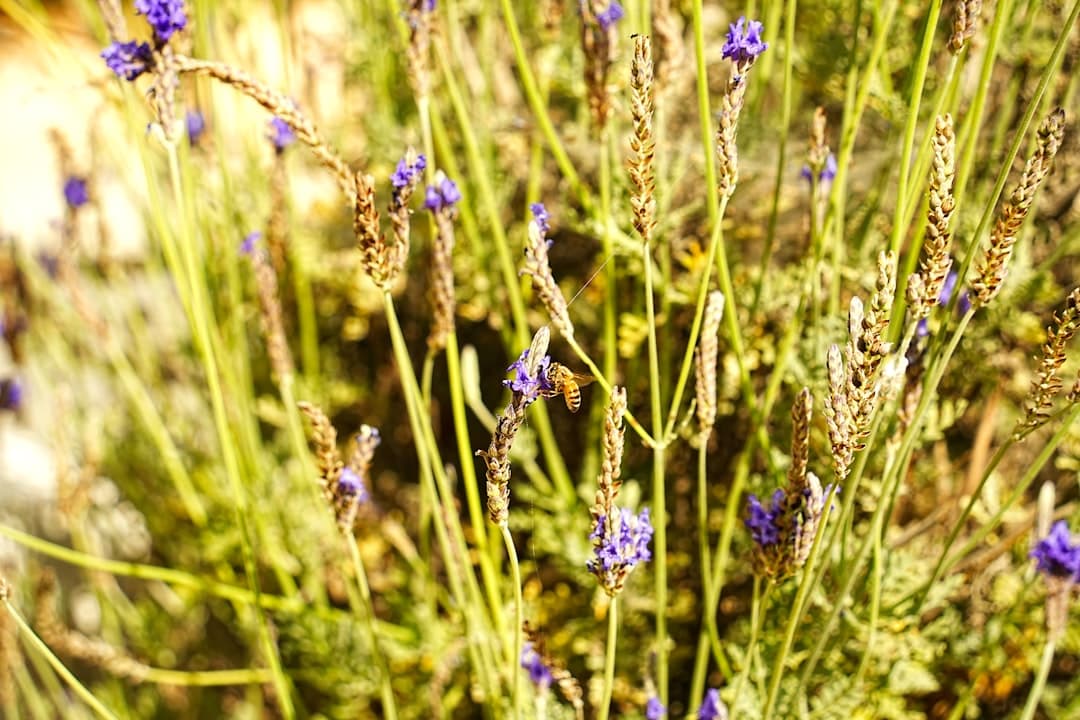
The planting carries half of the effect. We work mainly with drought-tolerant Mediterranean material, bougainvillea, oleander, olive, lavender and jasmine, which is listed on our own plant notes because it copes with the Cyprus climate. It also happens to behave well under light. An olive canopy breaks a beam into moving shadow. Bougainvillea takes colour strongly when grazed from below. Jasmine near a seating area pays back twice, once visually and once in scent on a warm night.
Avoid lighting a plant straight on from the front. Side light and uplight reveal structure; frontal light flattens it. And leave gaps. A terrace where every shrub is lit looks like a display, not a garden.
What the Cyprus climate does to fittings
Terraces are exposed. Sun, dust, irrigation overspray, pool water and, on coastal plots, salt-laden air all attack a fitting faster than a catalogue photograph suggests. Two things help. First, read the IP rating, defined in IEC 60529, and match it to the position: a fitting set into paving where water stands is a different case from one under a deep pergola. Second, look at the body material, the gasket and the lens, because that is where failures start.
Regional differences matter more than people expect. Limassol brings humidity and a lot of roof terraces, which changes both the fixing detail and the way corrosion behaves. Larnaca is the driest of the regions we serve, with roughly 330 mm of rainfall a year, irrigation restrictions in 2026, and slightly saline groundwater on plots near the salt lake, which affects planting choices around a terrace as much as the lighting. Regional climate figures for Cyprus are published by the Department of Meteorology if you want to check the pattern for your own area.
Controls and the discipline of switching off
A terrace with four zones and one switch gets used at one setting. Separate the circuits: orientation light on its own, table light on its own, atmosphere on a dimmer. Then most evenings run on two layers, and the full scheme is there when there are guests.
Timers and daylight sensors are useful, but a terrace is a social space with irregular hours, so keep a manual override within reach of the seating. It is also worth switching the garden layer off late at night, which is kinder to neighbours and to nocturnal wildlife.
Making it look like it was there all along
Our standard on a terrace is what we call Invisible Perfection: the result should look effortless, with the work hidden. In lighting terms that means cables routed before paving is laid where possible, transformers and drivers housed somewhere serviceable but out of sight, and fittings chosen to disappear by day.
It also means upkeep. Lenses cloud, gaskets harden, aiming drifts after a season of pruning. Our maintenance service covers Cyprus from our base in Paphos, with a dedicated maintenance team in Limassol and Larnaca, and a lighting check sits naturally alongside seasonal pruning and irrigation work.
Planning a terrace scheme
A terrace or small garden project typically takes one to two weeks, while a larger villa project with hardscaping, irrigation and mature planting usually runs three to six weeks. Those are typical spans from our own project notes rather than fixed dates, and any firm programme comes with a written proposal.
If you want to think through options before committing to anything, Gaia, the assistant on our site, can produce design mock-ups from a photograph of your terrace. Those visuals are AI generated images for discussion only, not photographs of completed work. Plant AI 2.0 can also give an indicative identification of what is already growing on the terrace, with a match score shown alongside the result, which is helpful as a starting point rather than a verdict.
For anything more detailed, a conversation on site is faster than any tool. Our initial consultation is free and carries no obligation, we aim to respond within 24 hours, and you can reach us on +357 99 245 332. Bring a photograph taken at dusk if you have one, because that is the hour the scheme has to work for.
Green Planet Gardening
Luxury garden design, construction, and maintenance across Cyprus. Founded by the Knodaritis brothers with over a decade of Mediterranean landscaping excellence.
Book a free consultation →Continue Reading
 Garden Design
 Garden Design
 Garden Design