
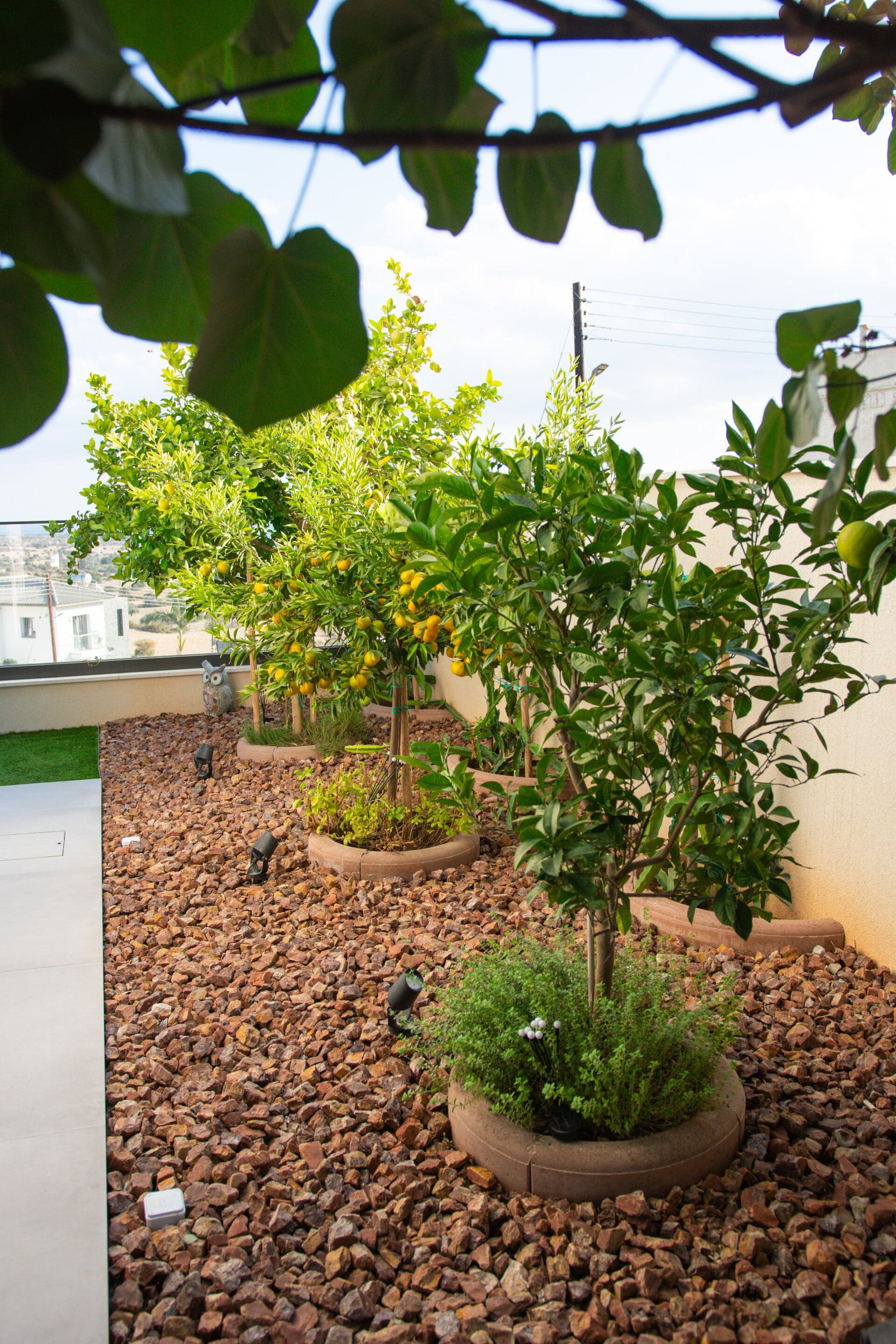
Xeriscaping vs a classic lawn garden — and why the best gardens use both.
An honest comparison for Cyprus villa owners — water, cost, look, upkeep and drought-resilience. No dogma: a real lawn genuinely wins on some things a water-wise garden can't.
Plan your garden on a site visit →Nothing quite replaces a soft green lawn
Let's be honest before we make the case for water-wise gardening: a real lawn is a genuinely beautiful thing, and there is no true substitute for it. Cool and soft underfoot, somewhere children play and you actually sit — that classic villa sward is worth wanting, and if you'll use it and water it, no drought-tolerant planting delivers quite the same feeling. Anyone who tells you a lawn is simply “wrong” for Cyprus is overstating it.
The honest catch is the water. A lawn covering a whole plot is the thirstiest thing you can plant on an island running short of water. So the real question isn't “lawn or no lawn” — it's how much lawn, and what surrounds it.
Water-wise garden vs classic lawn, point by point
| Water-wise garden | Classic lawn garden | |
|---|---|---|
| Water useEdge: water-wise | Low once established — planting chosen to live on little water. | High and constant, especially June–September; the biggest draw in the garden. |
| Look on day oneEdge: classic lawn | Takes a season or two to fill in and mature. | Instant lush green the moment it's laid. |
| Look through a Cyprus AugustEdge: water-wise | Holds its form and colour in the heat — it's built for it. | Needs steady watering to stay green; struggles the moment that slips. |
| Soft, usable spaceEdge: classic lawn | A garden to look at and walk through, not a surface to play or lie on. | A soft, cool sward for children, pets and bare feet — nothing replaces it. |
| Routine upkeepEdge: water-wise | Lower — no mowing; mainly pruning, mulching and seasonal tidying. | Higher — mowing, feeding and edging on a weekly rhythm. |
| Upfront costEdge: classic lawn | Often higher to design and plant well (structure, planting, drip, mulch). | Lower to establish from seed or turf. |
| Running cost over timeEdge: water-wise | Lower — far less water and labour year after year. | Higher — continuous water, feed and mowing. |
| Under watering restrictionsEdge: water-wise | Largely unaffected — it's designed for scarcity. | Directly at risk when irrigation is cut, as it was across parts of Cyprus in 2026. |
| Biodiversity & soilEdge: water-wise | Supports pollinators and living soil; varied planting. | A single-species surface with little for wildlife. |
| Best suited toIt depends | Owners who want a sustainable, low-water garden that stays composed year-round. | Households that genuinely use a lawn — and will water and maintain it. |
A water-wise garden wins on water, running cost and resilience; a lawn wins on instant impact and soft usable space. The best gardens borrow from both.
The case for water-wise isn't fashion — it's the reservoirs
Water-wise gardening in Cyprus isn't a trend; it's a response to hard numbers. Here's the reality every south-coast garden is designed against.
Cyprus averages about 500 mm of rain a year, and from June to August rainfall is almost negligible — under 5% of the annual total. A Cyprus garden is kept alive by irrigation and design, not by summer rain.
In February 2026 Cyprus's reservoirs held just 13.7% of capacity — the lowest dam inflows since records began in 1901 — and Paphos district enforced a 30% cut in irrigation water. On the south coast, water-wise planting is no longer optional.
About 70% of all water used in Cyprus goes to irrigation and roughly 20% to households. In a country this water-stressed, an efficient irrigation system and drought-tolerant planting are the difference between a garden that survives the summer and one that doesn't.
Figures verified against their sources ·
Water-wise everywhere, with one small lawn you actually use
The garden that makes sense in Cyprus now isn't a choice between a thirsty lawn and a gravel yard. It's a lush, drought-tolerant Mediterranean garden across most of the plot — colour and scent that hold through August — with one small, well-kept patch of real lawn where you sit or the children play. Beautiful and cool where you use it, sustainable everywhere else. That's the standard the best villas are moving to.
Read next: xeriscaping in Cyprus, a water-wise luxury garden plan, or the drought-resistant design guide.
More than a decade of high-end landscaping across Cyprus — private villas, boutique hotels, resort grounds and residential developments — delivered by a family team that treats every project like its own home.
Water-Wise Gardening, Answered
Xeriscaping is designing a garden to thrive on very little water — the right drought-tolerant planting, efficient drip irrigation, mulch and soil preparation, so the garden stays beautiful without constant watering. It suits Cyprus better than almost anywhere: the Mediterranean and native plants it relies on are exactly what grows here naturally, from olive, carob and oleander to lavender, rosemary, bougainvillea and ornamental grasses.
No — that's the biggest myth about it. Gravel and cacti are one narrow style; a well-designed water-wise garden in Cyprus is lush, layered and full of colour and scent, built from Mediterranean planting that happens to sip water rather than gulp it. Done properly it looks richer than a plain lawn, not sparser — the difference is that it holds that look through August instead of browning.
Yes, and for most gardens that's the ideal. The water-wise approach isn't anti-lawn — it's anti-wasted-water. Keeping one small patch of real lawn where people actually sit or children play, surrounded by drought-tolerant planting everywhere else, gives you the soft green space you want without irrigating the whole plot. That balance is becoming the high-end standard in Cyprus, not the compromise.
Over time, usually yes — a water-wise garden uses far less water and labour year after year, so the running cost is lower. The upfront cost can be higher, because designing and planting it well takes more thought than laying turf. So it often costs a little more to create and noticeably less to keep, which is why it pays off most for owners staying in a property for the long term.
Plants adapted to the Mediterranean climate: structural natives like olive, carob and cypress; flowering drought-lovers like oleander, bougainvillea, lantana, lavender, rosemary and teucrium; and ornamental grasses and succulents for texture. The art is combining them so something is in colour across the seasons while the whole garden lives on a fraction of a lawn's water.
They already are. In 2026 parts of Cyprus enforced cuts of around 30% to irrigation water amid the worst drought on record. A thirsty, lawn-dominated garden is directly exposed to those restrictions; a water-wise garden is largely insulated, because it was designed to need little in the first place. Planning for scarcity now is far cheaper than rescuing a garden after a restriction bites.
See also our garden design & landscaping, lawn care, and the artificial grass vs real lawn comparison.
Want a garden that stays beautiful on less water?
A site visit is where it starts — we'll read your plot, your exposure and how you use the garden, and design the balance of planting and lawn that fits. No obligation.
Arrange a site visit →