A wall light lives a harder life than almost anything else in a Cyprus garden. It is bolted to a south facing wall that stores heat all afternoon, it is washed by dust in spring, and on coastal plots it breathes salt air every single night. Plants can be replaced in a season. A row of failed fittings above a villa entrance is a different kind of problem, because the wall, the cabling and the plaster are involved too.
This is a look at what we consider before a single fixing hole is drilled, written for owners of villas and private residences who want lighting that still looks composed in its fifth summer.
Heat is the quiet destroyer
The usual failure on a Cyprus wall is not dramatic. Silicone gaskets harden, plastic diffusers go milky and brittle under ultraviolet light, and cheaply potted drivers cook inside a sealed body that sits against masonry radiating stored heat well after sunset. LED modules themselves are fairly patient, but the electronics behind them are not.
What helps: fittings that manage heat rather than trap it, glass rather than acrylic diffusers where the light sits in full sun, and remote drivers housed in a ventilated, shaded enclosure instead of inside the fitting body. On larger projects we plan driver locations at the same time as the cable runs, not afterwards.
Ingress protection, in plain terms
The IP rating you see quoted comes from IEC 60529. The first digit describes protection against solids such as dust, the second against water. For an exposed exterior wall in Cyprus, dust is the digit worth reading first, because fine airborne dust finds its way into any seal that was designed for a milder climate. A fitting that only resists dripping water is not the same as one built for wind driven rain across an open terrace.
Ratings are a starting point for a conversation, not a badge. Two fittings with identical figures on the box can behave very differently after four Cyprus summers, which is why we prefer specifications we have watched age on real walls.
Coastal air, and why Larnaca and Limassol differ
Our FAQ notes that Larnaca is the driest of the regions we serve, with around 330 mm of rainfall a year, irrigation restrictions for 2026, and slightly saline groundwater on plots near the salt lake. Limassol brings its own set of conditions: humidity, roof terraces and the red palm weevil (source: Green Planet Gardening homepage FAQ, greenplanetgardening.eu).
For lighting, those differences translate directly into material choices. Marine atmospheres are classified as more corrosive environments under ISO 9223, and that shows up as pitting on low grade stainless steel, weeping rust stains down pale render, and seized fixings that shear when a fitting is finally opened for service. Near the coast we lean towards 316 grade stainless steel, marine specification powder coated aluminium, solid brass or copper left to patinate on purpose, and we treat the fixings, the back plate and the gland as part of the same decision. A fine fitting on carbon steel screws will still stain a wall.
Light that flatters a Mediterranean garden
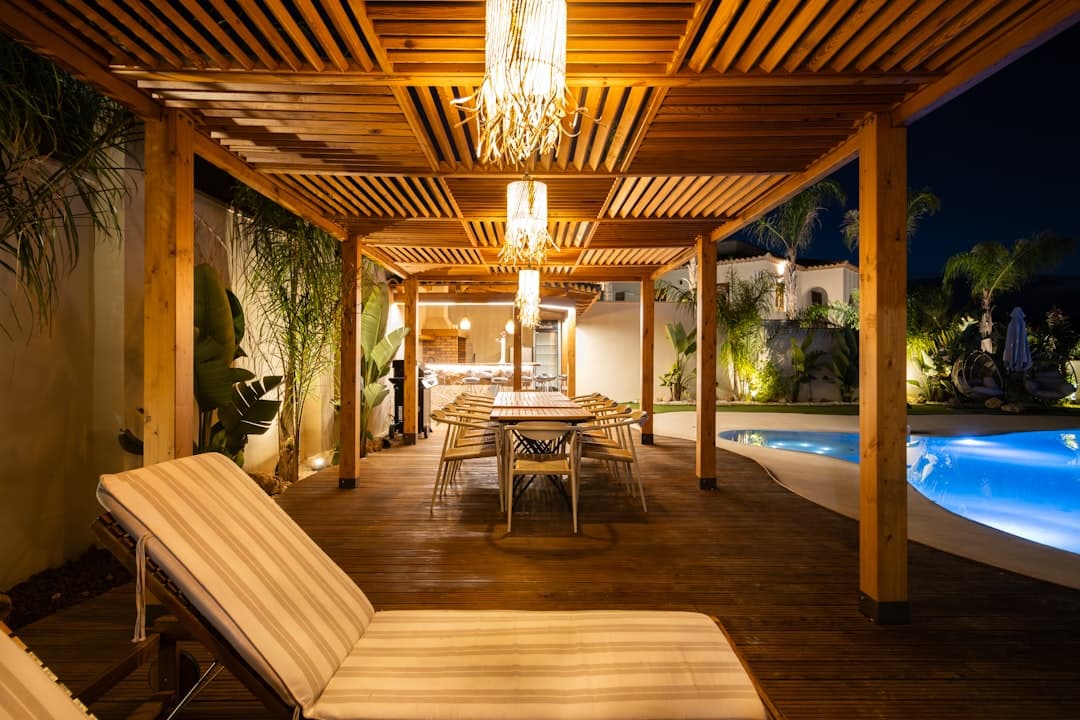
The engineering question is durability. The design question is restraint. Wall lights are close to eye level, so glare is the first thing a guest notices and the last thing anyone forgives. We favour shielded fittings that put light on surfaces rather than into faces, warm tones that sit kindly on limestone and render, and fewer, better placed points instead of a continuous line of bright dots.
DarkSky International sets out the same principle in its outdoor lighting guidance: light only where it is needed, only when it is needed, and no brighter than necessary. That approach also keeps a terrace pleasant on August evenings, when hard downlight on a pale wall turns a garden into a car park.
Up lighting a mature olive against a wall, grazing a dry stone surface, marking steps without lining them like a runway: these are the moves that make an evening garden feel like the daytime one. Our own idea of Invisible Perfection applies here too. If the guest notices the fittings before the garden, something has gone wrong.
Wiring, controls and the rules
Mains exterior work belongs with a qualified electrician working to the applicable Cyprus regulations, and supply matters are handled through the Electricity Authority of Cyprus. Low voltage systems reduce some of that burden but do not remove the need for correct cable sizing, proper glands and sensible circuit planning. Voltage drop over a long run to the far end of a villa boundary is a common cause of dim, mismatched lighting that no one can quite explain later.
Light sources sold in the EU also fall under Regulation (EU) 2019/2020 on ecodesign for light sources, which is worth knowing when you are comparing what is actually on the shelf.
One sustainability point made concretely rather than as a slogan: switching, zoning and timers reduce running hours, and reduced running hours extend the working life of drivers that are otherwise sitting in stored wall heat. Our website also carries a dedicated solar lighting section, which is useful where trenching a cable would mean cutting through finished hardscaping (source: greenplanetgardening.eu sitemap).
Maintenance is part of the specification
Specify a fitting you can service. That means access without dismantling stonework, gaskets that can be replaced, and glass that can be cleaned from a stable position. In practice most wall lighting on the island wants a wipe of the lens after the spring dust, a check of the gland and the fixings, and a look at the beam angle once nearby planting has grown.
Our maintenance teams work in Limassol and Larnaca, with clients across Cyprus including Nicosia and the surrounding areas, from our base in Paphos (source: Green Planet Gardening homepage FAQ). Lighting checks fit naturally into a maintenance visit that is already happening.
How this sits inside a project
On our own timings, a terrace or a small garden usually runs one to two weeks, while larger villa projects involving hardscaping, irrigation and mature planting typically take three to six weeks (source: Green Planet Gardening homepage FAQ). Lighting is decided early in that window, because conduit under a new terrace costs almost nothing to lay and a great deal to add later.
We work as a boutique operation, three brothers with more than a decade of work in Cyprus and a deliberately limited number of projects running at once, so the detail level on a lighting layout is the same as on the planting plan.
If you are planning a facade, an entrance or a terrace and want the lighting considered alongside the planting and the hardscaping, call us on +357 99 245 332. The first consultation is free and carries no obligation, and we reply within 24 hours (source: Green Planet Gardening homepage).
Green Planet Gardening
Luxury garden design, construction, and maintenance across Cyprus. Founded by the Knodaritis brothers with over a decade of Mediterranean landscaping excellence.
Book a free consultation →